






 Start With
 Include With
Understanding Ohm’s Law Formula: The Complete Guide
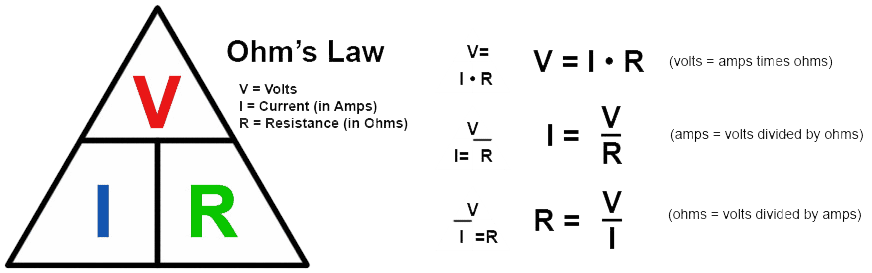
Ohm’s Law is a foundational principle in electronics and electrical engineering, describing the relationship between voltage, current, and resistance. This guide explores its history, formula, applications, and limitations, providing a comprehensive understanding for both beginners and enthusiasts.
Historical Background
Discovery: German physicist Georg Simon Ohm formulated Ohm’s Law in 1827 in his book Die galvanische Kette, mathematisch bearbeitet (The Galvanic Circuit Investigated Mathematically).
Initial Reception: Ohm’s work faced skepticism due to the primitive measurement tools of the time. It gained acceptance in the 1840s, revolutionizing electrical science.
The Ohm’s Law Formula
Ohm’s Law states that the current () through a conductor is directly proportional to the voltage () and inversely proportional to the resistance ().
Formula
Where:
= Voltage (Volts, V)
= Current (Amperes, A)
= Resistance (Ohms, Ω)
The Ohm’s Triangle
A mnemonic tool to rearrange the formula:
Cover the desired quantity:
To find , cover : .
To find , cover : .
To find , cover : .
Key Concepts Explained
Voltage (): The potential energy difference between two points, driving charge flow.
Current (): The rate of charge flow (electrons) through a conductor.
Resistance (): Opposition to current flow, converting electrical energy to heat.
Units
Voltage: Volts (V)
Current: Amperes (A)
Resistance: Ohms (Ω)
Practical Applications
Ohm’s Law is instrumental in:
Circuit Design: Selecting resistors to limit current (e.g., LED circuits).
Troubleshooting: Identifying faults by comparing measured vs. calculated values.
Power Management: Calculating power dissipation ().
Example Calculations
Finding Current:
Given , :
.Finding Voltage:
Given , :
.Finding Resistance:
Given , :
.
Beyond the Basics: Power Calculations
Power () in watts (W) can be derived using Ohm’s Law:
Example: A resistor with current dissipates:
.
Limitations and Non-Ohmic Materials
Ohmic Materials: Resistors with linear curves (follow Ohm’s Law).
Non-Ohmic Materials: Diodes, transistors, and filaments (non-linear relationships).
Example: Incandescent bulbs increase resistance as temperature rises.
Series and Parallel Circuits
Series Circuits:
Current is constant; resistances add:
Parallel Circuits:
Voltage is constant; reciprocals of resistances add:
Safety Considerations
Short Circuits: Low resistance causes excessive current (), risking overheating.
Protection: Use fuses/circuit breakers rated for expected current.
Tools for Measurement
Multimeters: Measure , , and .
Voltage: Measure in parallel.
Current: Measure in series (caution: high current can damage meters).
Common Misconceptions
Universal Applicability: Ohm’s Law applies only to ohmic materials.
AC vs. DC: In AC, impedance () replaces , incorporating inductance/capacitance.
Advanced Topics
Kirchhoff’s Laws: Build on Ohm’s Law for complex circuits.
Water Analogy: Voltage ≈ water pressure, current ≈ flow rate, resistance ≈ pipe narrowness.
Conclusion
Ohm’s Law is indispensable for analyzing and designing electrical systems. Mastery of this principle, combined with practical experimentation, forms the cornerstone of electronics. Whether calculating resistor values or diagnosing circuits, Ohm’s Law remains a vital tool in the engineer’s arsenal.
Kevin Chen
Founder / Writer at Rantle East Electronic Trading Co.,Limited
I am Kevin Chen, I graduated from University of Electronic Science and Technology of China in 2000. I am an electrical and electronic engineer with 23 years of experience, in charge of writting content for ICRFQ. I am willing use my experiences to create reliable and necessary electronic information to help our readers. We welcome readers to engage with us on various topics related to electronics such as IC chips, Diode, Transistor, Module, Relay, opticalcoupler, Connectors etc. Please feel free to share your thoughts and questions on these subjects with us. We look forward to hearing from you!