






 Start With
 Include With
What is 555 Timer: A Comprehensive Guide
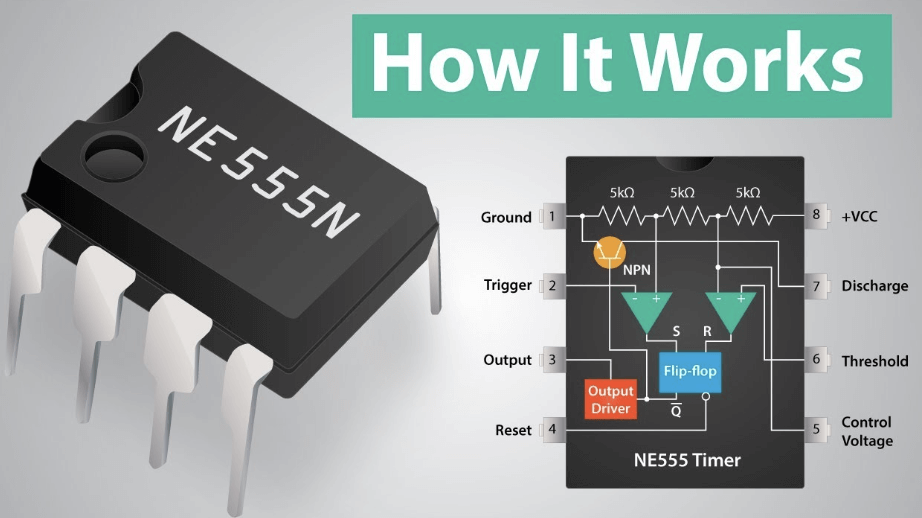
The 555 timer IC, introduced by Signetics in 1971 and designed by Hans Camenzind, is one of the most iconic integrated circuits in electronics. Renowned for its versatility, reliability, and low cost, it has become a staple in timing and pulse generation applications. This article explores its architecture, operating modes, applications, and design considerations.
Pin Configuration
The 555 timer is an 8-pin device with the following pinout:
GND (Ground): Connects to the circuit’s ground.
TRIG (Trigger): Active-low input that initiates timing in monostable mode.
OUT (Output): Drives loads (e.g., LEDs, relays) with up to 200 mA current.
RESET (Reset): Active-low input to halt timing immediately.
CTRL (Control Voltage): Adjusts comparator thresholds; often bypassed with a capacitor.
THRES (Threshold): Monitors capacitor voltage to end timing.
DISCH (Discharge): Provides a discharge path for timing capacitors.
VCC (Supply Voltage): Typically 4.5–15 V.
Internal Architecture
The 555 timer comprises:
Voltage Divider: Three 5kΩ resistors split VCC into 1/3 and 2/3 reference voltages.
Comparators: Compare input voltages (TRIG, THRES) to the references.
SR Flip-Flop: Controls the output state based on comparator signals.
Discharge Transistor: Sinks current to discharge external capacitors.
Output Buffer: Amplifies the flip-flop’s signal to drive loads.
Operating Modes
1. Astable Mode (Oscillator)
Generates a continuous square wave.
Circuit Configuration: Two resistors (R1, R2) and one capacitor (C).
Formulas:
Frequency:
Duty Cycle:
Note: Duty cycle >50% by default; add a diode parallel to R2 to achieve <50%.
Applications: LED flashers, clock generators, tone generation.
2. Monostable Mode (One-Shot)
Produces a single output pulse when triggered.
Circuit Configuration: One resistor (R) and one capacitor (C).
Formula:
Pulse Width:
Applications: Touch switches, debounce circuits, timers.
3. Bistable Mode (Flip-Flop)
Acts as a basic memory cell with SET (TRIG) and RESET inputs.
Circuit Configuration: No timing capacitor required.
Behavior:
TRIG (low) sets output HIGH.
RESET (low) sets output LOW.
Applications: Latches, toggle switches.
Applications
PWM Control: Modulate motor speed using the CTRL pin.
Voltage-Controlled Oscillator (VCO): Apply variable voltage to CTRL for frequency modulation.
Pulse Generation: Used in metronomes, alarms, and IR remotes.
Industrial Systems: Timing delays, waveform generation.
Variants and Enhancements
555 (Standard): Original bipolar version.
7555 (CMOS): Lower power consumption, higher frequency (up to 3 MHz).
556: Dual 555 in a single package.
Low-Voltage Versions: Operate at 2–5 V (e.g., LMC555).
Design Considerations
Component Selection:
Use ceramic capacitors for high-frequency stability.
Choose resistors in kΩ–MΩ range for timing intervals from μs to hours.
Noise Reduction: Bypass VCC with a 0.1 μF capacitor.
Leakage: Use low-leakage capacitors (e.g., tantalum) for long delays.
Output Load: Avoid exceeding 200 mA; use a transistor for higher currents.
Voltage Range: Ensure supply voltage stays within 4.5–15 V (standard 555).
Conclusion
The 555 timer’s simplicity and adaptability have cemented its place in electronics for over 50 years. Whether in educational projects, hobbyist circuits, or industrial systems, it remains a go-to solution for timing and oscillation needs. While modern microcontrollers offer precision, the 555 excels in quick, cost-effective implementations, proving that timeless design never goes obsolete.
Kevin Chen
Founder / Writer at Rantle East Electronic Trading Co.,Limited
I am Kevin Chen, I graduated from University of Electronic Science and Technology of China in 2000. I am an electrical and electronic engineer with 23 years of experience, in charge of writting content for ICRFQ. I am willing use my experiences to create reliable and necessary electronic information to help our readers. We welcome readers to engage with us on various topics related to electronics such as IC chips, Diode, Transistor, Module, Relay, opticalcoupler, Connectors etc. Please feel free to share your thoughts and questions on these subjects with us. We look forward to hearing from you!