






 Start With
 Include With
1N4148 vs. 1N4007: A Comprehensive Comparison
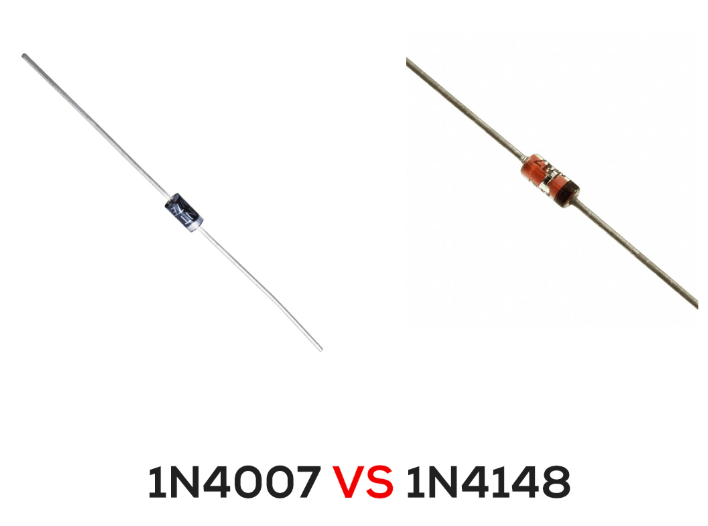
Diodes are fundamental components in electronics, and the 1N4148 and 1N4007 are two widely used types. While both serve as rectifiers, their design and applications differ significantly. This article explores their differences in detail.
1. Overview
1N4148: A high-speed switching diode designed for low-power, fast-switching applications.
1N4007: A general-purpose rectifier diode optimized for high-voltage, high-current power supply applications.
2. Key Specifications Comparison
| Parameter | 1N4148 | 1N4007 |
|---|---|---|
| Type | Small-signal switching diode | Power rectifier diode |
| Max Forward Current | 300 mA (continuous) | 1 A (continuous) |
| Peak Surge Current | 2 A (non-repetitive) | 30 A (non-repetitive) |
| Reverse Voltage | 100 V | 1000 V |
| Forward Voltage Drop | ~0.6–1 V (at 10 mA) | ~0.7–1.1 V (at 1 A) |
| Reverse Recovery Time | 4 ns (ultra-fast) | ~30 μs (slow) |
| Junction Capacitance | ~4 pF | Not specified (higher) |
| Package | DO-35 (small glass) | DO-41 (larger plastic) |
| Typical Cost | ~0.10 (bulk) | ~0.15 (bulk) |
3. Detailed Differences
3.1. Electrical Characteristics
Current Handling:
The 1N4007 handles up to 1 A continuously, making it suitable for power circuits. The 1N4148 is limited to 300 mA, ideal for signal-level applications.Voltage Rating:
The 1N4007’s 1000 V reverse voltage suits high-voltage rectification (e.g., mains AC), while the 1N4148’s 100 V rating is adequate for low-voltage circuits.Speed:
The 1N4148’s 4 ns reverse recovery time enables operation in high-frequency circuits (>100 MHz). The 1N4007’s 30 μs recovery time restricts it to low-frequency (50/60 Hz) applications.
3.2. Physical Design
Package and Size:
The 1N4148’s compact DO-35 glass package minimizes space, while the 1N4007’s larger DO-41 plastic package aids heat dissipation for higher current handling.Thermal Performance:
The 1N4007 dissipates more heat due to its higher current rating, requiring a robust package. The 1N4148 generates less heat, suited for low-power environments.
3.3. Applications
1N4148:
High-speed switching (e.g., digital logic, signal demodulation).
Clipping/clamping circuits, snubbers, and RF applications.
Protection circuits in low-current systems.
1N4007:
AC-to-DC rectification in power supplies.
Freewheeling diodes for relays/motors.
Reverse polarity protection in high-current systems.
4. When to Use Each Diode
Choose 1N4148 if:
You need fast switching (e.g., in pulse circuits or high-frequency signals).
The application involves low current (<300 mA) and moderate voltage (<100 V).
Choose 1N4007 if:
High voltage (up to 1000 V) or current (up to 1 A) is required.
The circuit operates at low frequencies (e.g., 50/60 Hz power rectification).
5. Interchangeability Considerations
Substituting 1N4007 for 1N4148:
Possible in low-frequency, high-voltage scenarios, but the slow recovery time may cause inefficiency or overheating in high-speed circuits.Substituting 1N4148 for 1N4007:
Risky due to lower current/voltage ratings. Likely to fail in power applications.
6. Alternatives
Similar to 1N4148:
1N914 (virtually identical).
BAT54 (Schottky diode for ultra-fast switching).
Similar to 1N4007:
1N5408 (3 A, 1000 V).
FR107 (Fast recovery diode for better efficiency).
Conclusion
The 1N4148 and 1N4007 cater to distinct niches: the former excels in high-speed, low-power signal circuits, while the latter dominates in high-voltage, high-current power rectification. Understanding their specifications ensures optimal performance and reliability in your designs. Always refer to datasheets for critical applications.
Kevin Chen
Founder / Writer at Rantle East Electronic Trading Co.,Limited
I am Kevin Chen, I graduated from University of Electronic Science and Technology of China in 2000. I am an electrical and electronic engineer with 23 years of experience, in charge of writting content for ICRFQ. I am willing use my experiences to create reliable and necessary electronic information to help our readers. We welcome readers to engage with us on various topics related to electronics such as IC chips, Diode, Transistor, Module, Relay, opticalcoupler, Connectors etc. Please feel free to share your thoughts and questions on these subjects with us. We look forward to hearing from you!