






 Start With
 Include With
What is RJ45 Connector: A Comprehensive Guide
The RJ45 connector is a cornerstone of modern networking, enabling reliable wired communication in Ethernet environments. Known for its versatility and standardization, this connector is integral to both residential and commercial networks. This guide explores its design, applications, and best practices for optimal use.
1. Definition and Overview
What is an RJ45 Connector?
The RJ45 (Registered Jack 45) is an 8-pin modular connector used primarily for Ethernet networking. It terminates twisted pair cables, facilitating high-speed data transmission.RJ45 vs. RJ11
Unlike the smaller RJ11 (used in telephone systems with 4-6 pins), the RJ45 has 8 pins and a larger form factor, supporting higher data rates.
2. Structure and Components
Physical Design
Housing: Plastic body with a locking tab to secure the connection.
Contacts: 8 gold-plated pins for conductivity and corrosion resistance.
Cable Compatibility: Works with Cat5, Cat5e, Cat6, Cat7, and Cat8 cables. Higher categories support increased bandwidth (e.g., Cat6 handles up to 10 Gbps).
Shielded (STP) vs. Unshielded (UTP)
UTP: Common in homes/offices; susceptible to electromagnetic interference (EMI).
STP: Includes a metal shield for industrial settings with high EMI.
3. Wiring Standards
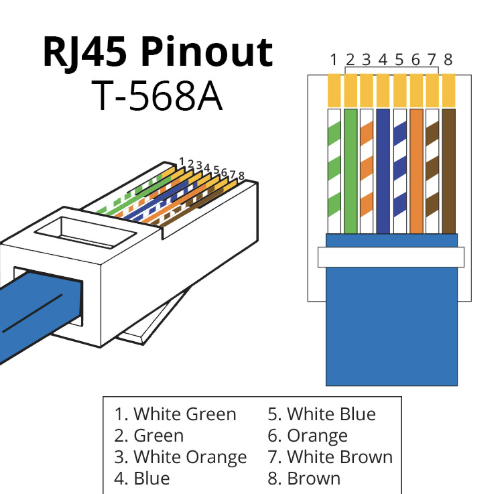
T568A and T568B
T568B: Predominant in the U.S., with wire order: Orange/White, Orange, Green/White, Blue, Blue/White, Green, Brown/White, Brown.
T568A: Used in government/global contexts; swaps green and orange pairs.
Consistency: Critical to avoid crossover issues. Mixing standards creates a crossover cable (historically for device-to-device connections; now often auto-detected).
4. Crimping Process
Tools Required
Crimping tool, wire stripper, cable tester, and RJ45 connectors.Step-by-Step Guide
Strip the Cable: Expose ~1 inch of twisted pairs.
Untwist and Arrange: Align wires to T568A/B.
Trim and Insert: Ensure wires are even and fully seated in the connector.
Crimp: Secure wires with a crimper.
Test: Use a cable tester to verify continuity and correct order.
5. Applications
Ethernet Networks: Connects computers, routers, and switches.
Power over Ethernet (PoE): Delivers power and data (e.g., IP cameras, VoIP phones).
Industrial Use: Shielded RJ45s in factories with heavy machinery.
Telecommunications: Legacy systems and structured cabling.
6. Advanced Considerations
Speed and Bandwidth
Cat5e: 1 Gbps up to 100m.
Cat6: 10 Gbps up to 55m.
Cat8: 40 Gbps up to 30m (ideal for data centers).
Durability Features
Reinforced tabs for frequent plugging/unplugging.
Weatherproof variants for outdoor use (IP67 rating).
7. Troubleshooting Common Issues
Faulty Connections
Miswiring: Test with a cable tester; re-crimp if necessary.
Broken Tab: Replace the connector to ensure a secure fit.
EMI Interference: Switch to STP connectors in high-noise environments.
8. Future Trends
Higher Speeds: Cat8 and emerging standards support 25-40 Gbps.
Backward Compatibility: RJ45 remains standard despite advancements in fiber optics.
Smart Connectors: Integrated diagnostics for network health monitoring.
FAQs
Can T568A and T568B be mixed?
Only for crossover cables; most modern devices auto-negotiate, reducing need.Does gold plating improve performance?
Yes, it enhances conductivity and reduces oxidation.Are RJ45 and Ethernet the same?
RJ45 is the connector; Ethernet refers to the networking protocol.
Conclusion
The RJ45 connector is a vital component in global networking infrastructure, evolving to meet rising demands for speed and reliability. By adhering to wiring standards, using quality components, and following best practices, users can ensure robust and future-proof connections. Whether for home use or enterprise data centers, the RJ45 remains indispensable in the connected world.
Kevin Chen
Founder / Writer at Rantle East Electronic Trading Co.,Limited
I am Kevin Chen, I graduated from University of Electronic Science and Technology of China in 2000. I am an electrical and electronic engineer with 23 years of experience, in charge of writting content for ICRFQ. I am willing use my experiences to create reliable and necessary electronic information to help our readers. We welcome readers to engage with us on various topics related to electronics such as IC chips, Diode, Transistor, Module, Relay, opticalcoupler, Connectors etc. Please feel free to share your thoughts and questions on these subjects with us. We look forward to hearing from you!