






 Start With
 Include With
What is Oscilloscope: A Comprehensive Guide
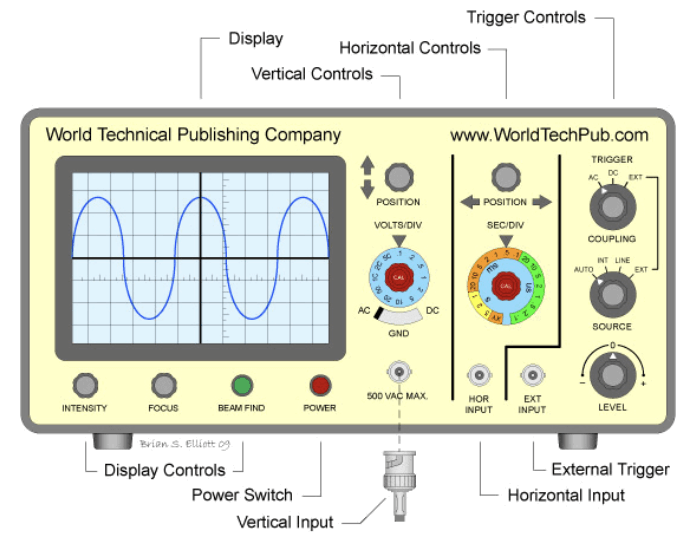
An oscilloscope, often referred to as an "o-scope" or simply "scope," is an essential electronic test instrument used to visualize and analyze electrical signals. By displaying voltage variations over time on a graphical interface, oscilloscopes provide insights into waveform characteristics, enabling engineers and technicians to debug circuits, measure signal integrity, and validate electronic designs. This article delves into the components, types, functionality, and applications of oscilloscopes, offering a detailed exploration of their role in modern electronics.
Components of an Oscilloscope
1. Display
Analog Oscilloscopes: Use a cathode-ray tube (CRT) to project electron beams onto a phosphor screen, creating real-time waveforms.
Digital Oscilloscopes: Employ LCD or LED screens to render digitized waveforms, often with enhanced features like color grading and persistence.
2. Vertical System
Controls the amplitude of the input signal. Adjustments include:
Volts/Div: Scales the vertical axis.
Coupling: Selects AC/DC/Ground input modes.
Position: Shifts the waveform vertically.
3. Horizontal System
Manages the timebase, determining how the signal is displayed over time:
Seconds/Div: Sets the time scale.
Trigger Holdoff: Delays subsequent triggers to stabilize complex waveforms.
4. Trigger System
Stabilizes repetitive waveforms or captures single-shot events. Common trigger types:
Edge Trigger: Activates on rising/falling edges.
Pulse Width Trigger: Detects pulses of specific durations.
Logic Trigger: Responds to digital logic conditions.
5. Probes
Connect the oscilloscope to the device under test (DUT). Key types:
Passive Probes (1x/10x): Attenuate signals (10x reduces loading effects).
Active Probes: Offer high bandwidth for high-frequency signals.
Compensation: Probes must be adjusted using a calibration square wave to match the oscilloscope's input impedance.
Types of Oscilloscopes
1. Analog Oscilloscopes
Mechanism: Directly amplify and display signals via CRT.
Use Case: Real-time visualization without digitization delays. Largely obsolete but valued for specific applications like adjusting analog audio equipment.
2. Digital Storage Oscilloscopes (DSO)
Mechanism: Convert analog signals to digital via an ADC (Analog-to-Digital Converter), storing data in memory for analysis.
Advantages: Waveform storage, automated measurements, and advanced triggering.
3. Digital Phosphor Oscilloscopes (DPO)
Mimic analog displays using a digital phosphor algorithm to highlight signal intensity and anomalies.
4. Mixed-Signal Oscilloscopes (MSO)
Combine analog channels with digital inputs (e.g., 8–16 digital lines), ideal for embedded systems debugging.
5. Sampling Oscilloscopes
Capture high-frequency signals (up to GHz) using equivalent-time sampling, suitable for telecommunications.
6. Portable and Handheld Oscilloscopes
Battery-operated, compact devices for fieldwork. Trade bandwidth for convenience.
7. PC-Based Oscilloscopes
Utilize a computer’s processing power and display via USB or Ethernet interfaces. Cost-effective for hobbyists.
How Oscilloscopes Work
Signal Pathway in Digital Oscilloscopes:
Probe Input: The signal enters through a probe, often attenuated (e.g., 10x).
Vertical Amplifier: Adjusts the signal amplitude.
ADC Conversion: Samples the signal at a specified rate (e.g., 1 GS/s) and converts it to digital.
Memory Storage: Captured data is stored in memory (e.g., 10 Mpts depth).
Processing: Applies math functions (e.g., FFT) or measurements (e.g., RMS voltage).
Display: Renders the waveform with time on the X-axis and voltage on the Y-axis.
Key Concepts:
Bandwidth: The maximum frequency a scope can measure (-3 dB point). For example, a 100 MHz scope can measure signals up to ~100 MHz with <30% amplitude error.
Sampling Rate: Must exceed twice the signal’s highest frequency (Nyquist Theorem) to avoid aliasing.
Rise Time: Calculated as . Critical for capturing fast transitions.
Key Specifications
Bandwidth: Determines high-frequency performance. Choose a scope with 3–5x the signal’s maximum frequency.
Sampling Rate: Higher rates (e.g., 5 GS/s) capture finer details.
Memory Depth: Affects how long a signal can be recorded at high resolution.
Channels: Most scopes offer 2–4 analog channels; MSOs add digital lines.
Triggering: Advanced options include serial protocol triggers and pulse qualification.
Applications
Electronics Design: Validate circuit behavior and signal integrity.
Troubleshooting: Identify noise, glitches, or timing issues.
Education: Teach waveform analysis in labs.
Automotive: Diagnose CAN bus signals or sensor outputs.
Power Analysis: Measure ripple, switching losses, and harmonics.
Telecom: Analyze modulation schemes in RF systems.
Choosing an Oscilloscope
Consider:
Bandwidth/Sampling Rate: Match to signal requirements.
Portability: Handheld for fieldwork vs. benchtop for labs.
Budget: Entry-level scopes (e.g., Rigol DS1054Z) start at ~50k.
Features: Protocol decoding, FFT, and connectivity (WiFi, USB).
Advanced Features
FFT Analysis: Converts time-domain signals to frequency domain for spectral analysis.
Automated Measurements: Calculate frequency, duty cycle, and rise time instantly.
Serial Protocol Decoding: Interpret I2C, SPI, UART, or USB data.
Waveform Math: Add, subtract, or integrate channels.
Safety Tips
Grounding: Use the oscilloscope’s ground connection to prevent electric shock.
Voltage Limits: Do not exceed probe ratings (e.g., 300 V for standard probes).
Isolation: Use differential probes for high-voltage measurements.
Historical Evolution
1920s: First commercial oscilloscopes by General Radio.
1946: Tektronix introduces triggered sweep, revolutionizing waveform stability.
1980s: Digital oscilloscopes emerge, enabling storage and advanced analysis.
Leading Manufacturers
Tektronix: Known for high-performance benchtop scopes.
Keysight Technologies: Offers industry-leading bandwidths.
Rigol/Siglent: Affordable options for education and hobbyists.
Rohde & Schwarz: High-end solutions for aerospace and telecom.
Conclusion
Oscilloscopes are indispensable tools in electronics, bridging the gap between theoretical design and real-world performance. From analog CRTs to digital powerhouses with protocol decoding, their evolution continues to empower innovation across industries. By understanding their specifications, features, and applications, users can harness their full potential to solve complex engineering challenges.
Kevin Chen
Founder / Writer at Rantle East Electronic Trading Co.,Limited
I am Kevin Chen, I graduated from University of Electronic Science and Technology of China in 2000. I am an electrical and electronic engineer with 23 years of experience, in charge of writting content for ICRFQ. I am willing use my experiences to create reliable and necessary electronic information to help our readers. We welcome readers to engage with us on various topics related to electronics such as IC chips, Diode, Transistor, Module, Relay, opticalcoupler, Connectors etc. Please feel free to share your thoughts and questions on these subjects with us. We look forward to hearing from you!