






 Start With
 Include With
What are Laser Diodes: A Comprehensive Guide
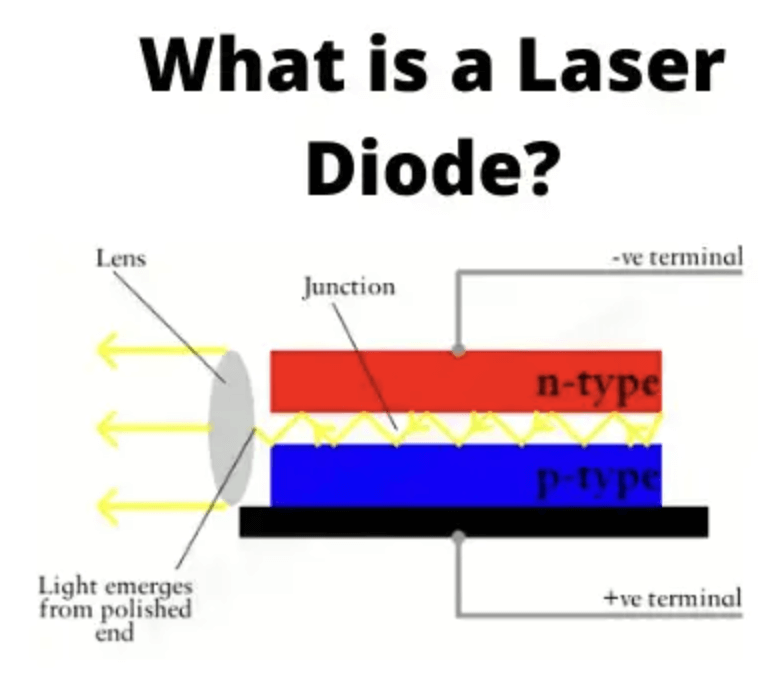
Laser diodes are compact semiconductor devices that generate coherent, monochromatic light through stimulated emission. Unlike conventional light sources (e.g., incandescent bulbs or LEDs), laser diodes produce a focused, high-intensity beam with minimal divergence. Their efficiency, small size, and ability to modulate light rapidly make them indispensable in modern technology, spanning telecommunications, medicine, and consumer electronics.
Historical Background
The development of laser diodes began in the early 1960s, shortly after the invention of the first ruby laser in 1960. Key milestones include:
1962: Robert N. Hall demonstrated the first homojunction laser diode using gallium arsenide (GaAs), operating at cryogenic temperatures.
1970: Zhores Alferov and Herbert Kroemer independently developed heterojunction laser diodes, enabling room-temperature operation and higher efficiency. Their work earned them the 2000 Nobel Prize in Physics.
1980s–1990s: Advances in quantum well structures, vertical-cavity surface-emitting lasers (VCSELs), and materials like indium phosphide (InP) expanded applications into fiber optics and optical storage.
Working Principle
Laser diodes operate on the principle of stimulated emission, a process predicted by Einstein in 1917. Key concepts include:
1. Semiconductor Structure
A p-n junction forms the core, with the active region (often a quantum well) where electrons and holes recombine.
Heterojunction design (e.g., AlGaAs/GaAs) confines carriers and photons, enhancing efficiency.
2. Optical Feedback
Mirrors at the diode’s cleaved facets create an optical cavity, reflecting photons to sustain lasing.
When population inversion is achieved, stimulated emission dominates over spontaneous emission.
3. Threshold Current
Lasing begins when the gain exceeds losses (e.g., absorption, scattering). Below this current, the device behaves like an LED.
Structure and Types
Laser diodes vary in design based on application:
1. Edge-Emitting Laser Diodes (EELs)
Light emits from the edge of the chip.
Common in high-power applications (e.g., fiber lasers).
2. Vertical-Cavity Surface-Emitting Lasers (VCSELs)
Light emits perpendicular to the surface.
Low power consumption; used in data centers and facial recognition (e.g., smartphones).
3. Distributed Feedback (DFB) and Distributed Bragg Reflector (DBR) Lasers
Incorporate gratings for single-mode, wavelength-stable output.
Ideal for telecommunications.
4. Quantum Cascade Lasers (QCLs)
Use intersubband transitions in quantum wells for mid-infrared emission.
Applied in gas sensing and spectroscopy.
5. High-Power Diode Lasers
Arrays or bars used in industrial cutting/welding and pumping solid-state lasers.
Key Characteristics
Wavelength: Ranges from ultraviolet (GaN) to infrared (InGaAsP), depending on material.
Output Power: From milliwatts (VCSELs) to kilowatts (stacked arrays).
Efficiency: Typically 30–70%, far higher than gas lasers.
Modulation Bandwidth: Up to tens of GHz for high-speed data transmission.
Beam Quality: Trade-off between divergence and focus (e.g., VCSELs have circular beams; EELs require collimation).
Materials and Wavelengths
GaAs/AlGaAs: 750–1100 nm (infrared; used in CD/DVD drives).
InGaAsP/InP: 1200–1700 nm (telecommunications C-band).
GaN/InGaN: 400–500 nm (blue/violet; Blu-ray, LiDAR).
Applications
Telecommunications: Fiber-optic networks rely on 1550 nm DFB lasers for data transmission.
Optical Storage: Blu-ray uses 405 nm GaN diodes for high-density data.
Medical: Dermatology (hair removal), surgery (precision cutting), and ophthalmology (retinal repair).
Industrial: Cutting, welding, and additive manufacturing.
Sensing: LiDAR for autonomous vehicles, environmental monitoring.
Consumer Electronics: Laser printers, barcode scanners, smartphone depth sensors.
Advantages and Challenges
Advantages
Compact size and lightweight.
High efficiency and direct electrical modulation.
Long lifespan (>100,000 hours).
Challenges
Thermal management (efficiency drops with temperature).
Beam divergence requires collimation optics.
Sensitivity to optical feedback (requires isolators).
Recent Advances and Future Trends
Quantum Dot Lasers: Improved temperature stability and wavelength flexibility.
Silicon Photonics: Integrating laser diodes with silicon chips for faster data processing.
UV-C Lasers: Germicidal applications for water/air purification.
Beam Combining: Coherently stacking diodes for kilowatt-class systems.
Safety Considerations
Laser diodes are classified under IEC 60825 standards:
Class 1: Eye-safe under normal use (e.g., DVD players).
Class 3B/4: Hazardous; require protective eyewear (industrial lasers).
Conclusion
Laser diodes revolutionized technology by merging semiconductor physics with photonics. Ongoing research into materials, thermal management, and integration promises to unlock new applications in quantum computing, augmented reality, and sustainable energy. As the demand for faster, smaller, and more efficient systems grows, laser diodes will remain at the forefront of photonic innovation.
Kevin Chen
Founder / Writer at Rantle East Electronic Trading Co.,Limited
I am Kevin Chen, I graduated from University of Electronic Science and Technology of China in 2000. I am an electrical and electronic engineer with 23 years of experience, in charge of writting content for ICRFQ. I am willing use my experiences to create reliable and necessary electronic information to help our readers. We welcome readers to engage with us on various topics related to electronics such as IC chips, Diode, Transistor, Module, Relay, opticalcoupler, Connectors etc. Please feel free to share your thoughts and questions on these subjects with us. We look forward to hearing from you!